
The AI reads sensitive data, so we made sure it never sees the person.
Credit files are full of names, tax IDs, and financial statements. Klerum is built so the AI never sees the personal data in them: documents are redacted before any model call, and the math a rating turns on is deterministic code, not AI. We pair that with the isolation, access control, and audit logging community-bank reviews require.
The model never sees the borrower.
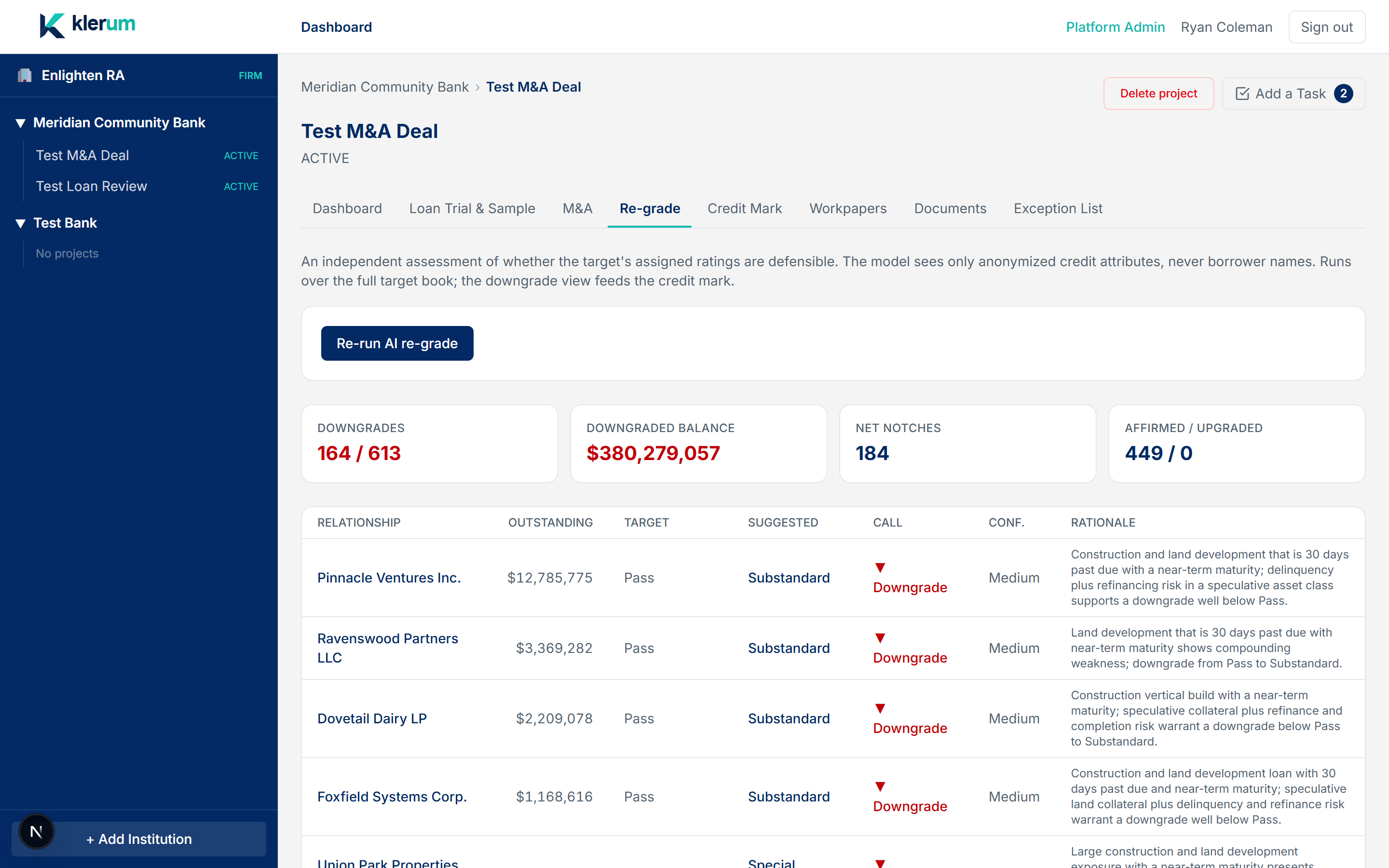
Klerum's core rule is simple: personal information never reaches the AI. Before a document is sent to the model, an in-perimeter OCR and named-entity service tokenizes every name, SSN, and tax ID, and the response is rehydrated on our own servers.
- Names, SSNs, and tax IDs become tokens like
[PERSON_1]and[SSN_1]before anything leaves the perimeter - Model output is rehydrated server-side, so reviewers still see real names
- Redaction fails closed — if it is unavailable, the AI does not run at all
- The redaction boundary is enforced in code, not by convention
The numbers are computed, not generated.
Every ratio a review turns on — DSCR, LTV, net worth, combined coverage, sampling math — is deterministic, unit-tested code. The AI fills inputs and drafts language; it never computes the number a rating depends on. That is what makes an AI output something a reviewer, and an examiner, can actually rely on.
Isolation and accountability by default.
Multi-tenant isolation
Every query is scoped by institution, with an organization-level firewall between firms. One bank's data never crosses into another's.
Access control
JWT-based authentication with edge-runtime RBAC middleware enforces the firm-side and portal-side split, scoped by access tier.
Audit logging
Every change to a relationship is recorded with actor, timestamp, and diff, the evidence trail an examiner expects.
Frameworks we build toward.
- GLBA
- Privacy and data-protection practices for financial information.
- FFIEC
- Aligned with loan-review and risk-management guidance.
- State banking
- Accommodates requirements that vary by FI jurisdiction.
- SOX
- Relevant where reviews cover publicly-traded institutions.
Where the data lives, and for how long.
- PII and CUI: borrower names, SSNs, tax IDs, and financial statements are access-controlled, audit-logged, and redacted before any AI call.
- Retention: loan-review documentation is typically retained 7 or more years, in line with regulatory expectations.
- Data residency: US-only hosting is available for institutions that require it.
Honest current state
We do not have a formal SOC 2 attestation yet. It is a planned priority as our paying-customer base grows. It is not a blocker for community-bank pilots, but we will not claim it before it is done. A vendor security questionnaire is available on request, and we are happy to walk your team through our architecture and roadmap.
See Klerum on your own portfolio.
A 30-minute demo, no deck. Upload a sample trial and watch the AI propose a review population against your methodology.